

AI-based risk scoring model in AUDAVIS AI

In this video, Benjamin Aunkofer explains the AI-based risk scoring model in AUDAVIS AI, how it can be configured for each client and how auditors can use it.
In the risk-based audit approach, AI-based risk scoring can help the auditor map inherent risk at the level of individual entries in a much more granular and data-driven way. Instead of assessing risks only on a general level for the financial statements or processes, transactions are evaluated on the basis of specific anomaly indicators such as unusual account combinations, manual interventions, special posting times or atypical posting texts, and prioritized by risk. This allows the auditor to increase the depth of testing specifically where an elevated inherent risk actually exists, while inconspicuous areas with lower risk require less intensive examination. This not only improves the quality and accuracy of the audit but also increases its efficiency.
AUDAVIS AI-based risk scoring and the configuration of the scoring model
How AI-based risk scoring works in AUDAVIS
AI-based risk scoring refers to the systematic assessment of individual entries or transactions based on defined risk indicators in order to specifically prioritize conspicuous matters within large data sets. Unlike traditional selection approaches, which are often based primarily on the amount, such scoring takes a large number of attributes into account, such as unusual account combinations, manual entries, and anomalies in timing, users or posting texts. These factors are condensed into an overall score that indicates which entries are more likely to be relevant from an audit perspective. The aim is not to prove errors automatically, but to give the auditor a sound, traceable and risk-based basis for further audit procedures.
What AI-based scoring means for the auditor
AI-based risk scoring can be superior to classic monetary unit sampling (MUS) in that it evaluates audit-relevant anomalies not only by their materiality in terms of amount but on the basis of a broader understanding of risk. MUS is particularly suitable for covering large individual amounts and the resulting risks of error, but reaches its limits where risks do not lie in large amounts. Manipulations, deliberately scattered smaller entries, unusual account combinations, manual interventions or conspicuous entries shortly before the end of the period are often underrepresented in a purely amount-based selection. AI-based scoring captures such anomalies more systematically because it considers several risk indicators at the same time, enabling a more differentiated prioritization within the entire population. It does not necessarily replace MUS in every situation, but it provides a much more precise basis for selecting further audit procedures, especially for complex data sets and risk-based audit approaches.
Would you like to audit analytically too? Feel free to sign up here for a demo.
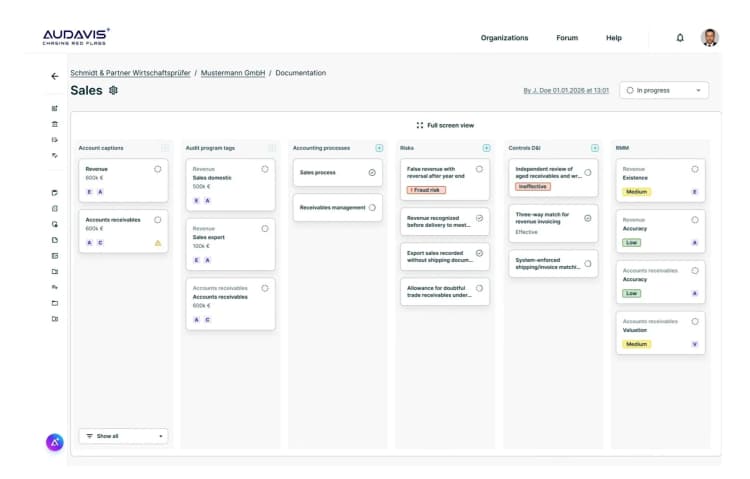
AUDAVIS - KI-gestützte Dokumentation für die Abschlussprüfung
AUDAVIS bietet ab 2027 die vollwertige Dokumentation der Abschlussprüfung als Nutzer-Funktion mit KI-Unterstützung.

KI-gestützte Individual-Analysen für Prüfer

Offset Account Analysis in Financial Statement Audits
Analyzing the posting relationships between accounts and their offset accounts is one of the most revealing audit procedures in general ledger analysis.