

Completeness Testing of the General Ledger

Completeness Testing of the General Ledger
The completeness of the transactions recorded in the general ledger is one of the fundamental assertions in a financial statement audit. An incomplete general ledger leads directly to a distorted view of net assets, financial position and results of operations and can render the entire financial statements unusable. Precisely because missing entries – unlike incorrect entries – leave no visible traces in the system, completeness testing is one of the most demanding audit procedures of all.

The figure shows completeness testing of the general ledger in AUDAVIS. Both the reconciliation of debit and credit amounts and the reconciliation between the journal and the trial balance are performed automatically.
The importance of completeness in the general ledger
The general ledger is the central data source of the financial statements. All of a company's transactions must be recorded there without gaps and in the correct period so that the balance sheet and income statement can give a true and fair view. The completeness assertion – referred to in the international standards on auditing as completeness – requires evidence that all transactions, assets and liabilities that must be recognized are actually included in the accounting records.
This assertion is particularly critical for expenses and liabilities: while a company may have a natural interest in recording income and assets in full, the reverse case creates an incentive for deliberate or unintentional understatement. The auditor must therefore examine with particular care whether all transactions economically belonging to the fiscal year are actually reflected in the general ledger.
Typical indicators of incompleteness
Missing entries rarely reveal themselves directly. However, indications can be obtained from various directions: gaps in document number ranges, unexpected jumps in account balances, unusually low balances on expected expense accounts, open items in sub-ledgers without a corresponding entry in the general ledger, and significant deviations from the prior year or from industry expectations. Matters that have been contractually agreed but not recorded – such as continuing obligations, leases or guarantees – are also among the classic risk areas.
Testing completeness means auditing the invisible – anyone who only looks at what is there will never discover what is missing.
Regulatory basis
Under Section 239 (2) of the German Commercial Code (HGB), completeness is one of the fundamental principles of proper bookkeeping. In addition, the assertion is explicitly addressed in the international standards on auditing: ISA 315 requires a risk-based identification of completeness risks, ISA 330 builds on this by requiring appropriate audit procedures, and ISA 500 sets out the requirements for the quality of audit evidence. The German auditing standard IDW PS 261 also expressly emphasizes the importance of the completeness assertion within the risk-based audit approach.
Limits of manual completeness testing
Traditional completeness procedures rely on backward reconciliations – from the document to the entry – and on sample-based analyses of subsequent periods. The auditor reviews incoming invoices in January and February of the following year to assess whether they still belong to the fiscal year just ended. For larger clients, however, this approach quickly reaches its limits: the sheer volume of documents makes a gapless manual audit impossible, and samples can only provide isolated indications.
In addition, systematic gaps – such as entire business units or company codes that were not transferred to the general ledger – can hardly be detected reliably in a manual audit. In these cases, the auditor has to rely on the internal control system and on plausibility considerations.
Data-driven completeness testing
Modern audit platforms deliberately rely on the analysis of structured data to systematically uncover completeness risks. The analysis begins with an automated check of document number ranges: gaps or duplicates become immediately visible. In addition, all general ledger and sub-ledger accounts are examined for formal consistency – for example by reconciling the totals of the sub-ledgers with the control accounts in the general ledger.
Furthermore, multi-year comparisons are performed across account levels to identify unusually low expense or revenue accounts. Analyzing entries after the balance sheet date – known as subsequent events testing – uncovers transactions that economically belong to the year under audit but were only recorded in the following year. All anomalies are consolidated in a risk-based working paper.
The added value of automated testing in audit practice
In AUDAVIS, data-driven completeness testing takes just one click. This simple analytical procedure complements the auditor's professional judgment with a comprehensive analytical perspective. Instead of isolated samples, the client's entire accounting data is systematically examined for indicators of incompleteness. The auditor can focus in-depth testing on the identified risk areas while gaining a significantly higher level of audit assurance.
Especially for complex clients with several company codes, foreign subsidiaries or a heterogeneous system landscape, automated analysis creates a reliable basis for a well-founded audit conclusion on the completeness of the general ledger.
AUDAVIS automatically tests the general ledger for completeness, detects gaps in document numbers and identifies systematic risks – for a well-founded audit conclusion and an audit-proof working paper.
Learn more at www.audavis.ai
AUDAVIS – the AI platform for financial statement audits. Automated working papers, risk analyses and intelligent data analytics for auditors.
Would you like to audit analytically too? Feel free to sign up here for a demo.
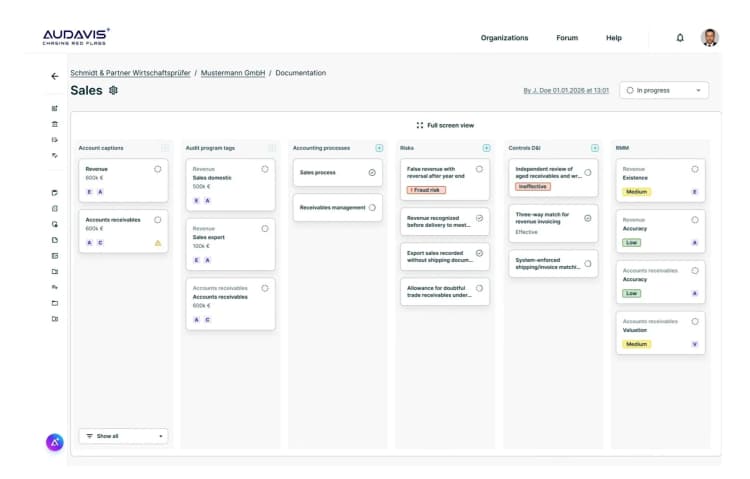
AUDAVIS - KI-gestützte Dokumentation für die Abschlussprüfung
AUDAVIS bietet ab 2027 die vollwertige Dokumentation der Abschlussprüfung als Nutzer-Funktion mit KI-Unterstützung.

KI-gestützte Individual-Analysen für Prüfer

Offset Account Analysis in Financial Statement Audits
Analyzing the posting relationships between accounts and their offset accounts is one of the most revealing audit procedures in general ledger analysis.