

Cut-off analysis in AUDAVIS
The accrual-based allocation of transactions to the correct period is one of the central areas of a financial statement audit. If income or expenses and the corresponding items in accounts receivable or payable are allocated to the wrong fiscal year, this has a direct impact on a company's net assets, financial position and results of operations. Cut-off testing ensures that transactions around the balance sheet date have been recorded correctly – a task that is error-prone and time-consuming when performed manually.
What does cut-off mean in a financial statement audit?
The term cut-off (also: testing of period-end accruals) describes the allocation of transactions to the correct reporting period. In accordance with the German commercial law principles of proper bookkeeping (reporting date principle), every transaction must be recorded in the period in which it was economically caused – regardless of when payment is made.
In practice, this means that a delivery of goods shipped on December 28 of a year, for example, may only be recognized as revenue in the fiscal year just ended if the transfer of risk also took place in December of the old year.
Typical risks in period-end cut-off
Cut-off errors are among the most frequent findings in financial statement audits. The reasons are manifold: late postings of incoming invoices, incorrect accrual entries at year-end, premature revenue recognition for earnings management, or deferred items that were not released. The complexity increases considerably, especially for companies with high transaction volumes and several company codes.
Practice shows: the higher the transaction volume, the greater the likelihood of cut-off errors – and the more important a systematic, data-driven audit becomes.
Traditional audit approaches and their limits
Traditionally, cut-off testing is performed on a sample basis. The auditor selects entries around the balance sheet date and compares them with documents such as delivery notes, invoices or contracts. This approach is methodologically sound but reaches its limits with large volumes of data. Samples cover only a fraction of the transactions, so material errors can remain undetected.
In addition, manually evaluating accounting data around the balance sheet date ties up considerable resources. Identifying conspicuous posting patterns – such as an accumulation of reversals in early January or unusually high accrual entries at the end of December – requires experience and a systematic approach.
Data-driven cut-off analysis with AI
The AI-supported audit platform AUDAVIS enables a complete analysis of all entries in the relevant cut-off period. Instead of being limited to samples, the entire accounting data is evaluated systematically. Data analytics algorithms automatically identify transactions that are conspicuous in relation to the period of performance: entries with atypical document dates, backdating, unusual posting patterns shortly before or after the balance sheet date, and significant individual entries in accrual accounts.

The benefits are considerable: the auditor receives a risk-based overview of all relevant transactions, can align audit procedures specifically with the identified anomalies and documents the analysis in an automatically generated working paper.
In AUDAVIS, cut-off analyses can of course be combined and cross-filtered with the AI-based risk scoring model, so that, for example, high-risk transactions in particular are brought into focus for the cut-off analysis.
Relevance for audit practice
Cut-off testing is far more than a formal compulsory exercise. It is an essential tool for uncovering deliberate earnings management and for ensuring that the financial statements are properly allocated to periods. Precise period-end cut-off is of central importance, particularly in industries with seasonal fluctuations, long-term construction contracts or complex supply chains.
By using AUDAVIS as an intelligent analysis system, the auditor can perform this demanding audit procedure more efficiently and at the same time more comprehensively. The combination of professional judgment and data-driven analysis creates the basis for a high-quality and reliable audit conclusion.
AUDAVIS supports auditors with automated cut-off analysis and creates risk-based working papers – for greater audit assurance and efficiency in financial statement audits.
Would you like to audit analytically too? Feel free to sign up here for a demo.
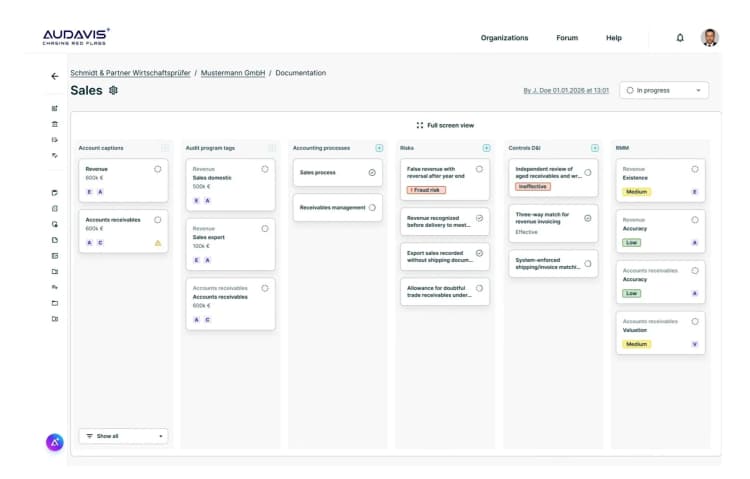
AUDAVIS - KI-gestützte Dokumentation für die Abschlussprüfung
AUDAVIS bietet ab 2027 die vollwertige Dokumentation der Abschlussprüfung als Nutzer-Funktion mit KI-Unterstützung.

KI-gestützte Individual-Analysen für Prüfer

Offset Account Analysis in Financial Statement Audits
Analyzing the posting relationships between accounts and their offset accounts is one of the most revealing audit procedures in general ledger analysis.