

Expectation Analyses with AUDAVIS
The expectation analysis of personnel expenses is a substantive analytical procedure that can be derived from the requirements of ISA 520 (Analytical Procedures). The aim is to derive a traceable expectation for the amount of personnel expenses for the fiscal year currently under audit and to compare it systematically with the actual value. This robust method creates transparency: it shows whether the development of personnel expenses is plausible in light of business performance, whether there are material deviations between expected and actual values, and whether any deviations can be explained. For the auditor, it is a method for identifying material anomalies in the accounting data that contradict their current understanding of the personnel expenses line item.
To ensure that analytical procedures do not become a time-consuming chore, AUDAVIS offers structured automation of such audit procedures.
AUDAVIS expectation analyses of personnel expenses (YouTube)
Example audit approach for personnel expenses
In many companies, an efficient process-oriented audit approach to personnel expenses is appropriate. The auditor first assesses the inherent risk of the line item based on knowledge of the company and the industry, as well as inquiries and initial insights into the financial statements. In the next step, the process and its control steps are analyzed. Often, payroll software is used in which the payroll journals are maintained and payment approvals and master data changes are carried out. Within these processes, there are often strict internal controls to ensure that errors can hardly occur. By understanding this process and testing the controls, the auditor can therefore already significantly reduce the remaining risk. If this is the case and there are no significant risks relating to the line item, the auditor can often conclude the audit of the ongoing personnel expenses during the year with an analytical review of personnel expenses. This analytical procedure has to confirm the risk assessed in the process audit once again at line item level, with a particular focus on completeness and accuracy. The audit procedure thus ensures that personnel expenses are not materially understated in the financial statements, so that the auditor ultimately obtains confirmation of the risk assessment and can conclude with reasonable assurance that the line item is free from error.
How expectation analysis works in AUDAVIS
In AUDAVIS, the process starts with all entries on personnel expenses being automatically added to the dashboard for the audit procedure. The auditor can dynamically add the other key parameters, such as changes in the number of FTEs, collectively agreed and non-tariff salary adjustments and special effects. Significant bonuses or severance payments in particular should be clarified with the client in advance wherever possible, as they can change personnel expenses abruptly.
Based on this information, AUDAVIS creates an expected value for the personnel expenses of the year under audit and compares it with the actual value. If the deviation is within performance materiality, this part of the analysis can usually be concluded as plausible.
In the next step, the payroll-related costs are also checked for plausibility. To do this, the social security contribution rate from the prior year is rolled forward and used to derive an expected value for the fiscal year. This expected value is also compared with the actual value and the deviation is assessed. If the deviation between the expected and actual value does not exceed performance materiality, the payroll-related costs can be considered plausible.
If the deviations in either of the two areas exceed performance materiality, AUDAVIS supports the root cause analysis: AUDAVIS displays the posting volumes of the line items graphically, and drill-downs make it possible to quickly identify conspicuous periods and entries and to raise the decisive questions with the client in no time.
Finally, the audit procedure can be finalized using integrated documentation functions, exported as a finished working paper and filed either as a link to the dashboard or as a PDF in the documentation tool of your choice, so that the method, the result and the clarification of deviations are documented in a traceable manner.
Why this audit procedure is more than a comparison of figures
The expectation analysis of personnel expenses not only provides a plausibility check of a financial statement line item. It enables an overall economic view of the personnel area and supports the assessment of whether the company manages its personnel and payroll-related cost processes properly and controls them in a traceable manner. Precisely because personnel expenses are among the largest expense items in many organizations, this audit procedure is an effective building block for substantiating the plausibility of how the personnel area is reflected financially.
Would you like to audit personnel expenses analytically too? Sign up for a demo.
More substantive audit procedures
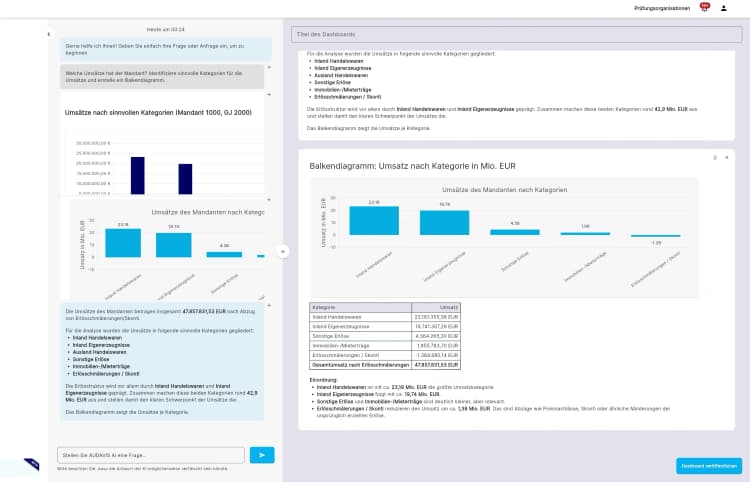
KI-gestützte Individual-Analysen für Prüfer

Offset Account Analysis in Financial Statement Audits
Analyzing the posting relationships between accounts and their offset accounts is one of the most revealing audit procedures in general ledger analysis.