

AUDAVIS AI - Reconciliation between the ledgers

Significance of the audit procedure for the financial statement audit
Reconciling the general ledger with the sub-ledgers is a fundamental audit procedure that ensures that the financial statements are based on a consistent and complete data basis. In particular, it is important for the auditor to know whether the sub-ledgers, where many of the tests of details take place, flow into the actual general ledger – the basis for the financial statements – without reconciliation differences.
How the general ledger and sub-ledgers interact
The general ledger forms the central basis of the financial statements. It contains the balances of all general ledger accounts and serves as the basis for preparing the balance sheet and income statement. The sub-ledgers – in particular the accounts receivable and accounts payable sub-ledgers – hold the detailed individual items, which then flow into the general ledger accounts linked to the sub-ledgers.
Causes of differences
In a consistent accounting system, the totals of the sub-ledgers must match the corresponding control accounts in the general ledger exactly. In practice, however, differences occur regularly. The most common causes of differences between the various posting levels are:
- Systematic errors in the accounting system's automatic control account determination
- Missing entries due to systemic interface errors
- Especially in system migrations, no migration of sub-ledger data but only of general ledger information
- Manual correcting entries in the general ledger without adjusting the matter in the actual process at sub-ledger level
- In the worst case, even fraudulent activity, because "earnings cosmetics" are applied at general ledger level
Manual reconciliation vs. automated analysis
Manual reconciliation of the general ledger and sub-ledgers is typically performed using Excel-based trial balances from the general ledger and sub-ledgers. The auditor compares the sub-ledger balances with the control accounts in the general ledger and investigates any differences found. For clients with several ERP systems or complex posting structures, this process, including clarifying deviations, can take considerable time.
Automated analysis platforms such as AUDAVIS, by contrast, enable a complete reconciliation in a fraction of the time. All account movements are compared systematically, and differences are classified by materiality and presented to the auditor in a structured overview.

More time for what matters
An effective GL-SL reconciliation not only provides the auditor with a list of differences but also with an assessment of their relevance. Material deviations are highlighted automatically, while minor rounding differences or timing-related deviations are identified accordingly. This enables a risk-based audit with the focus on the matters that are actually material. The auditor can thus address follow-up questions at a completely different speed.
In addition, the automated analysis documents the entire reconciliation process in an audit-proof working paper. The auditor receives a transparent presentation of the reconciliation procedures performed, the differences identified and the audit steps derived from them.
AUDAVIS performs the reconciliation between the general ledger and sub-ledgers automatically, identifies differences and creates audit-ready working papers – for a complete and efficient reconciliation.
Learn more at www.audavis.ai
AUDAVIS – the AI platform for financial statement audits. Automated working papers, risk analyses and intelligent data analytics for auditors.
Would you like to audit analytically too? Feel free to sign up here for a demo.
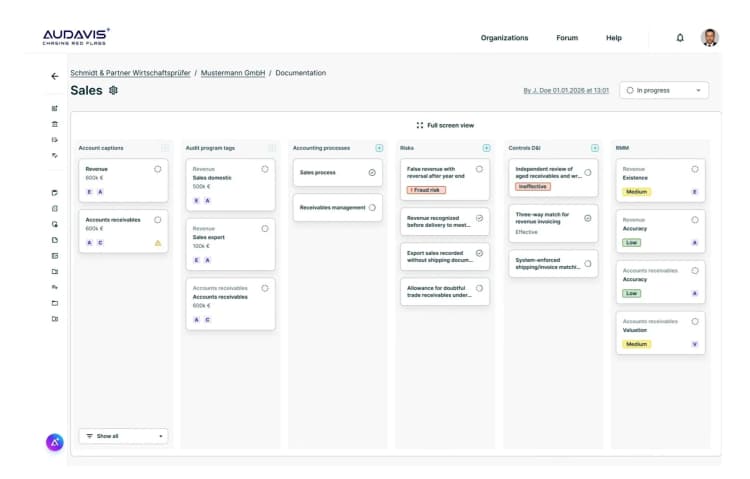
AUDAVIS - KI-gestützte Dokumentation für die Abschlussprüfung
AUDAVIS bietet ab 2027 die vollwertige Dokumentation der Abschlussprüfung als Nutzer-Funktion mit KI-Unterstützung.

KI-gestützte Individual-Analysen für Prüfer

Offset Account Analysis in Financial Statement Audits
Analyzing the posting relationships between accounts and their offset accounts is one of the most revealing audit procedures in general ledger analysis.